
What Landlords, Vendors and Estate Agents Need to Know
From 1 October 2026, new Minimum Evidence Requirements for Energy Performance Certificates (EPCs) will come into force across England and Wales. The changes are particularly important for landlords, property vendors, estate agents and letting agents arranging EPC assessments.
The new requirements have been introduced by the Energy Assessor Scheme Operating Board (EASOB) and establish a consistent minimum level of evidence that accredited energy assessors must collect and retain when producing an EPC. The aim is to improve the accuracy, consistency and auditability of energy assessments.
What is changing with EPCs in October 2026?
Energy assessors already collect photographs, measurements, floor plans and supporting information during an EPC survey. However, from 1 October 2026, a more detailed standardised evidence framework will apply across accreditation schemes.
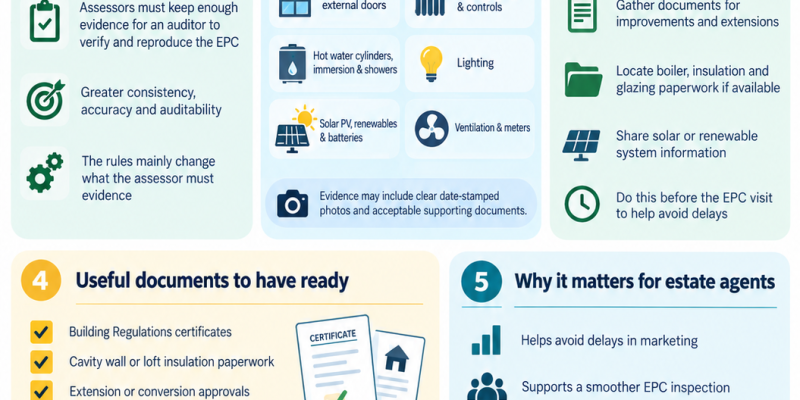
The fundamental principle is that the assessor’s evidence should be sufficient for an auditor to reproduce the EPC and verify the information entered into the assessment software.
For property owners and agents, this could mean EPC inspections become more evidence-focused and that assessors may need clearer access to parts of the property.
What evidence will an EPC assessor need?
Depending upon the property, the assessor will need evidence covering areas including:
Floor plans and measurements – Clear plans covering every level of the property, dimensions, floor-area calculations, room layouts, heat-loss walls and party walls.
Walls, roofs, floors and insulation – Photographs or acceptable supporting documentation establishing the construction and insulation of the property. Loft photographs should demonstrate both the measured insulation depth and its coverage.
Windows and external doors – Evidence of the different glazing types and external doors present at the property.
Heating and heating controls – Evidence of boilers, heat pumps and other heating systems, together with identification details where available, radiators or other heat emitters, thermostats, programmers and heating controls.
Hot water systems – Cylinders, insulation, thermostats, immersion heaters and relevant shower types may need to be recorded.
Lighting – Assessors will need sufficient evidence of the types of lamps installed in fixed light fittings.
Renewable technologies – Solar PV, solar thermal systems and other renewable technologies must be appropriately evidenced.
Ventilation and meters – Relevant ventilation systems, electricity meters, renewable-energy meters and battery-storage characteristics may also require supporting evidence.
Photographs used as evidence should be clear and date-stamped and, where possible, geo-tagged. Documentary evidence may sometimes supplement photographs, but it must relate specifically to the property and meet the applicable RdSAP evidence conventions.
What should landlords and vendors do before an EPC assessment?
Although these requirements apply directly to accredited assessors, landlords and homeowners can help ensure their EPC accurately reflects their property.
Before the assessment, gather any documents relating to energy improvements that may not be obvious from visual inspection.
Useful information can include:
-
- Building Regulations completion certificates
- cavity wall insulation guarantees
- loft or roof insulation documentation
- extension or conversion completion records
- window installation certificates
- boiler or heating installation documentation
- solar PV information
- evidence of internal or external wall insulation.
Government EPC guidance already recommends providing information about when a property was constructed and whether it has subsequently been extended or improved. The assessor remains responsible for validating information used in the assessment.
This becomes increasingly important where an improvement cannot be physically verified. Without acceptable evidence, the assessor may have to use the applicable RdSAP default or age-related assumption rather than simply accepting that work has been carried out.
What do estate agents and letting agents need to know?
For estate and letting agents, the main practical change is to ensure clients understand that an EPC assessment is more than simply obtaining the certificate.
Agents should encourage sellers and landlords to provide full property access and locate supporting documentation before the assessor arrives.
An EPC is already required when applicable before a property is marketed for sale or rent, and an agent acting for the seller or landlord must be satisfied that an EPC has been commissioned where no valid certificate exists.
Allowing sufficient time for a comprehensive assessment can therefore help avoid unnecessary delays in marketing.
Why are the EPC evidence requirements changing?
The Government has welcomed the new Minimum Evidence Requirements as part of a wider programme designed to increase quality, consistency and trust in Energy Performance Certificates.
For landlords and sellers, better evidence should ultimately mean that an EPC provides a more reliable representation of the property’s energy performance.
Need an EPC before selling or letting your property?
Eden Energy EPC Solutions provides accredited domestic EPC assessments for landlords, homeowners, vendors and property professionals across Southport, Sefton, Liverpool, Merseyside and surrounding areas.
With the new EPC Minimum Evidence Requirements taking effect from 1 October 2026, using an experienced accredited Domestic Energy Assessor can help ensure that relevant property features and improvements are properly identified, evidenced and recorded.