
EPC Guide for Homeowners & Landlords
What Should I Expect and Provide the Assessor to Obtain an EPC for My Property?
Information for homeowners, landlords and property agents
Understanding RdSAP 10
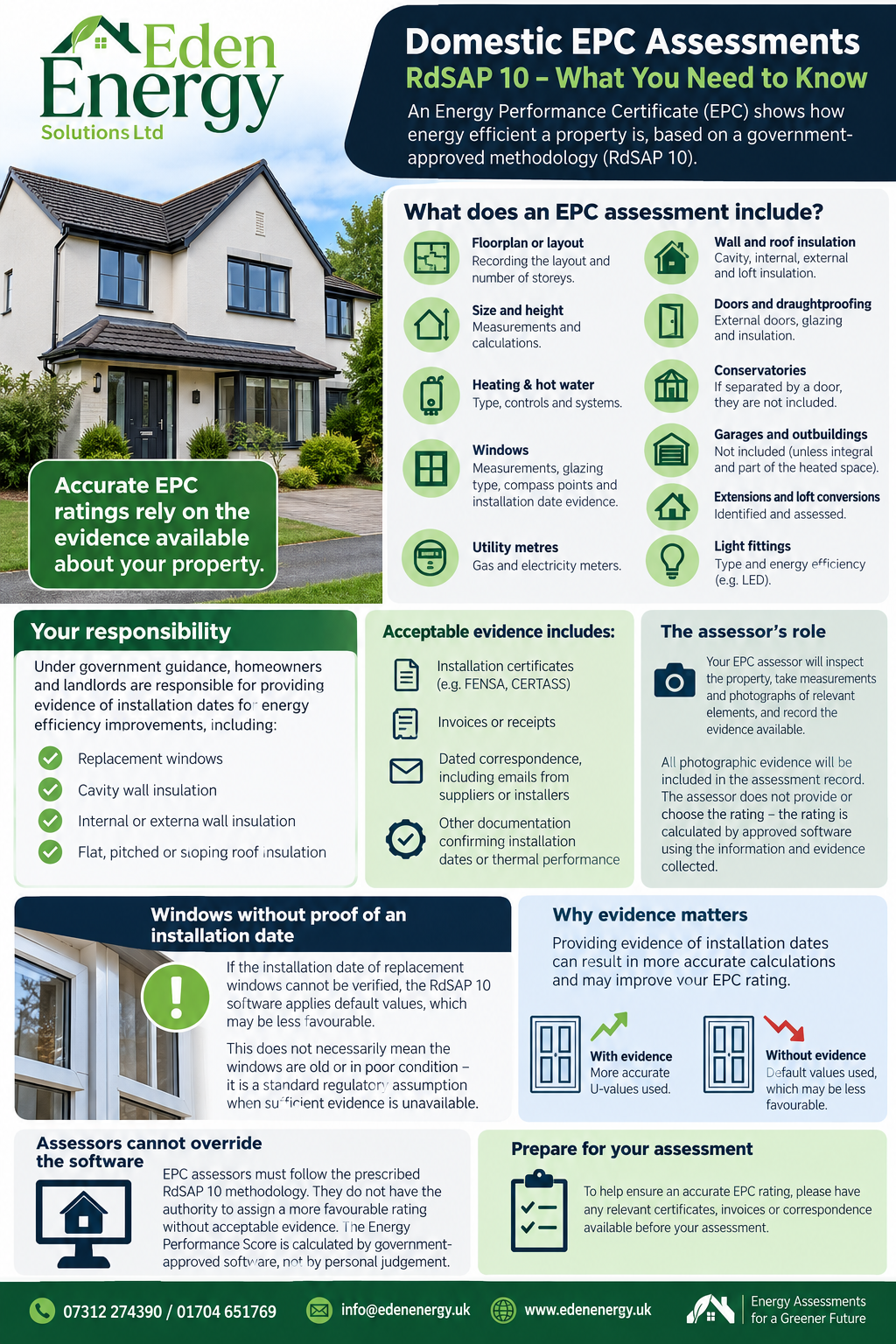
The Reduced Data Standard Assessment Procedure (RdSAP 10) is the government-approved methodology used to calculate Energy Performance Certificates (EPCs) for existing domestic properties. Introduced on 15 June 2025, it requires detailed measurements, inspections and supporting evidence to describe a dwelling accurately.
What does the EPC assessment include?
Floor plan and layout: The configuration of the dwelling, storeys, room divisions and relevant building parts.
Dimensions: Floor areas, ceiling heights and other measurements needed for the calculation.
Heating and hot water: Boilers, heat pumps, electric heating, cylinders, controls, thermostats and system types.
Windows: Measurements and compass orientations of windows, glazing and frame types, and acceptable evidence of installation dates.
Utility meters: Relevant electricity and gas meter information, including smart and export capability where applicable.
Walls and roofs: Construction, accessible insulation, loft spaces, flat and pitched roofs and sloping ceilings.
Doors: External door type, relevant thermal characteristics, glazing and draughtproofing details.
Conservatories: Whether the conservatory qualifies as thermally separated. A qualifying conservatory separated by suitable external-quality doors/windows is generally excluded from floor area; an ordinary internal door alone may not qualify.
Garages and outbuildings: Separate unheated outbuildings and typical garages are normally excluded; attached or integral spaces are considered under the methodology.
Extensions and loft conversions: Different building parts, conversion dates, room-in-roof construction and insulation.
Lighting: Fixed light fittings and energy-efficient lamps such as LEDs.
Your role: provide installation evidence
Homeowners and landlords should supply any evidence they hold for replacement windows and energy-efficiency improvements, particularly cavity-wall insulation, internal or external wall insulation, and insulation in flat, pitched or sloping roofs. This may allow the assessor to record information more precisely instead of relying on prescribed assumptions.
Useful records include FENSA/CERTASS or Building Control certificates, installer guarantees, dated invoices or receipts, and supplier or installer correspondence (including emails) identifying the property, work carried out and installation date. Acceptability depends on the particular RdSAP convention and the information the document proves.
The assessor also inspects and photographs accessible features where appropriate. Photographs support the assessment record, but they do not automatically prove a concealed insulation specification or historical installation date.
Windows with an unknown installation date
Under RdSAP glazing-age conventions, the assessor must use “unknown” when the date cannot be established by an accepted route. Evidence may also be visible on a dated spacer bar or frame, or supported by other methods allowed by the conventions.
Where the age or performance cannot be verified, the approved software applies the relevant default values. These can be less favourable than values supported by evidence and may reduce the calculated EPC score. This does not mean that the windows are physically defective, poorly maintained or necessarily inefficient: it is a calculation assumption, not a condition survey.
Who determines the EPC rating?
The Domestic Energy Assessor inspects, measures, records and evaluates evidence. The Energy Performance Score and EPC band are then calculated by approved software using the prescribed methodology. Assessors cannot choose a more favourable result or override evidence requirements merely because an installation looks recent or the owner expects a particular grade.
If sufficient evidence is unavailable, the assessor must apply the current RdSAP rules and defaults. The EPC is a standardised model of energy performance, not a personal judgement by the assessor.
Before your appointment
Please make available any relevant installation documents and safe access to the loft, heating and hot-water equipment, meters and other areas that may need inspection. The assessor will explain any evidence limitations noted during the visit.
Eden Energy Solutions Ltd
171 Southport Road, West Lancashire, PR8 5LE | 07312 274390 / 01704 651769
info@edenenergy.uk | www.edenenergy.uk
Guidance note: This sheet describes the RdSAP 10 assessment process and applicable evidence principles. It does not impose a new universal legal duty to retain every installation record. Specific recording decisions depend on current conventions and the evidence available.